Enter Your Data
Typical range: 35-85 ml/kg/min
Don't Know Your VO2 Max?
Estimate from recent race: Use our VO2 Max Calculator with a recent race time to determine your current VO2 max.
→ Calculate Your VO2 MaxPredicted Race Times
Enter your VO2 max to see predicted race times
Endure Weekly
Want to keep improving?
Get your free Zone 2 training guide plus one short training email each Wednesday.
Free. No spam. Unsubscribe anytime.
Track Your VO2 Max Progress
Modern running watches estimate VO2 max from your workout data - track your fitness over time without lab testing.
Affiliate Disclosure: As an Amazon Associate, we earn from qualifying purchases at no additional cost to you.
Men's VO2 Max Standards
| Category | Age 20-29 | Age 30-39 | Age 40-49 |
|---|---|---|---|
| Elite | 60+ | 58+ | 55+ |
| Excellent | 52-60 | 50-58 | 48-55 |
| Good | 47-51 | 44-49 | 42-47 |
| Fair | 42-46 | 40-43 | 37-41 |
| Poor | <42 | <40 | <37 |
Women's VO2 Max Standards
| Category | Age 20-29 | Age 30-39 | Age 40-49 |
|---|---|---|---|
| Elite | 55+ | 52+ | 50+ |
| Excellent | 47-54 | 45-51 | 42-49 |
| Good | 42-46 | 39-44 | 36-41 |
| Fair | 37-41 | 35-38 | 32-35 |
| Poor | <37 | <35 | <32 |
Training to Improve VO2 Max
VO2 Max Intervals
- • 5×5 minutes @ 95-100% max HR
- • 8×3 minutes @ 95-100% max HR
- • 3-5 minute recoveries
- • 1-2 sessions per week max
Tempo Runs
- • 20-40 minutes @ threshold
- • 85-90% max HR
- • Improves lactate clearance
- • Supports VO2 max gains
Aerobic Base
- • 70-80% of training volume
- • Zone 2 heart rate
- • Builds mitochondria
- • Foundation for VO2 max
VO2 Max Requirements by Goal
5K Goals:
- • Sub-25 min: ~40-42 ml/kg/min
- • Sub-22 min: ~45-47 ml/kg/min
- • Sub-20 min: ~50-52 ml/kg/min
- • Sub-18 min: ~55-58 ml/kg/min
- • Sub-16 min: ~62-65 ml/kg/min
Marathon Goals:
- • Sub-4:30: ~38-40 ml/kg/min
- • Sub-4:00: ~42-44 ml/kg/min
- • Sub-3:30: ~48-50 ml/kg/min
- • Sub-3:00: ~54-56 ml/kg/min
- • Sub-2:30: ~62-65 ml/kg/min
Frequently Asked Questions About VO2 Max & Race Prediction
How accurate is VO2 max for predicting race times?
VO2 max predictions are 85-95% accurate for well-trained runners, with highest accuracy for 5K-10K distances which rely most heavily on aerobic power. Longer distances like marathons depend more on lactate threshold, running economy, and fueling, making predictions less precise. Use these predictions as training benchmarks rather than exact race targets.
What VO2 max do I need to run a sub-20 minute 5K?
For a sub-20 minute 5K, you typically need a VO2 max of 48-52 ml/kg/min for men and 44-48 ml/kg/min for women. However, exceptional running economy can allow lower VO2 max athletes to achieve this time, while poor economy may require higher values. Training specifically for 5K pace is also crucial.
What VO2 max is needed for a sub-3 hour marathon?
A sub-3 hour marathon typically requires a VO2 max of 54-58 ml/kg/min for men and 50-54 ml/kg/min for women. However, marathon performance depends heavily on lactate threshold (the % of VO2 max you can sustain), fueling strategy, and training volume. Many sub-3 marathoners have VO2 max values in the low-to-mid 50s but excellent economy and threshold.
Why are my predicted race times different from my actual times?
Several factors cause discrepancies: 1) Running economy - how efficiently you use oxygen affects pace independently of VO2 max; 2) Race-specific training - if you've trained for one distance, other predictions may be off; 3) Course conditions - hills, heat, and altitude affect performance; 4) Pacing strategy - poor race execution impacts results; 5) Lactate threshold - determines how much of your VO2 max you can actually use.
How do I improve my VO2 max for faster race times?
The most effective VO2 max training includes: 1) High-intensity intervals at 95-100% max HR (5×5 min or 8×3 min with equal recovery); 2) Tempo runs at lactate threshold; 3) Consistent aerobic base training in Zone 2; 4) Progressive overload over 8-12 week cycles. Most runners can improve VO2 max by 5-15% with dedicated training, with beginners seeing the largest gains.
Is VO2 max or lactate threshold more important for race performance?
Both matter, but their importance varies by distance: 1500m-5K relies heavily on VO2 max; 10K-half marathon balances both; marathon and beyond depends more on lactate threshold and running economy. Elite marathoners can sustain 85-88% of VO2 max for the entire race, while recreational runners may only sustain 70-75%, making threshold training crucial for longer distances.
What's a good VO2 max for my age?
VO2 max naturally declines with age (approximately 5-10% per decade after 30), so standards adjust by age group. For men aged 30-39: Elite 58+, Excellent 50-57, Good 44-49, Fair 40-43. For women aged 30-39: Elite 52+, Excellent 45-51, Good 39-44, Fair 35-38. Consistent training can slow this decline significantly, with active 60-year-olds often having VO2 max values higher than sedentary 30-year-olds.
Can I predict ultra marathon times from VO2 max?
Ultra marathon predictions from VO2 max are less reliable because these events depend more on: 1) Fat oxidation efficiency; 2) Stomach/gut tolerance for extended fueling; 3) Mental fortitude and pain tolerance; 4) Heat management; 5) Experience with ultra-specific pacing. VO2 max provides a ceiling for performance, but ultramarathon success often comes from athletes who can sustain a higher percentage of that ceiling for longer periods through specific training.
Featured at Backcountry — 15% off first order
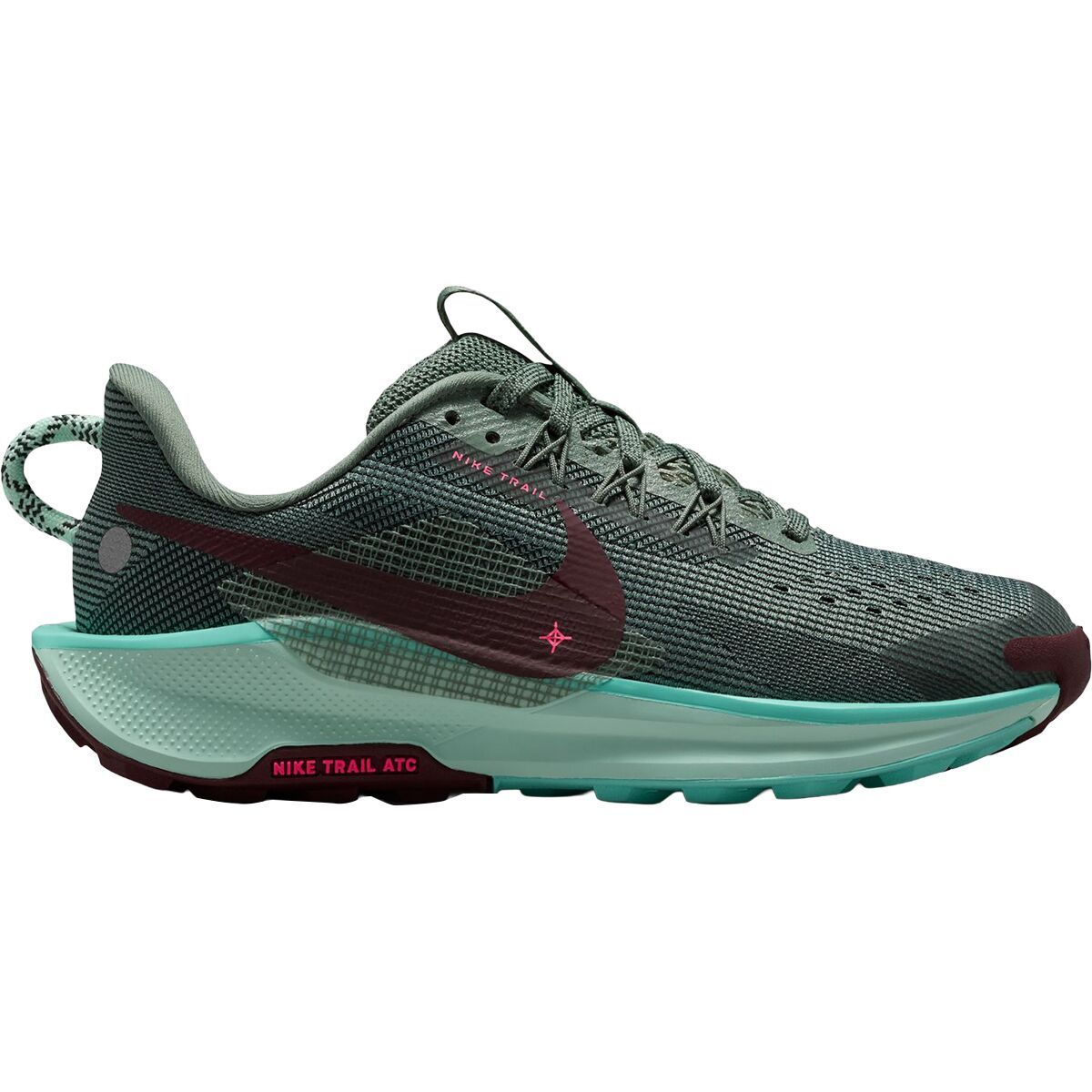
Nike Pegasus Trail 5
Our go-to trail-capable training shoe. React foam + sticky outsole.